
Karbala: the family of the Prophet


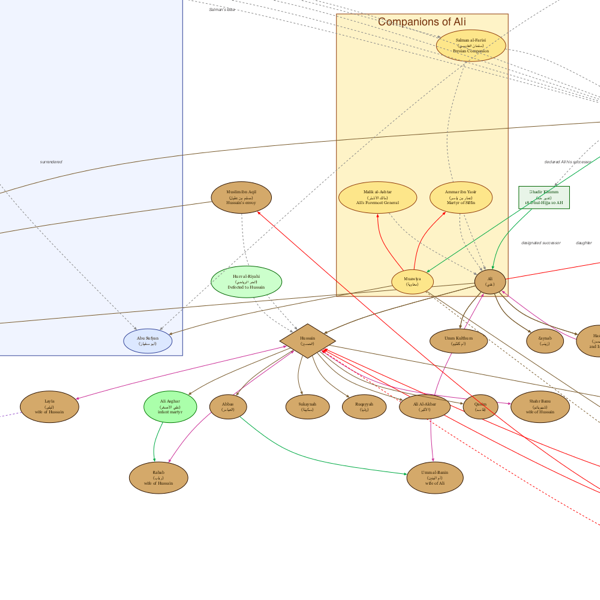



A genealogy of the prophetic lineage (Adam → Noah → Ibrahim → … → Muhammad ﷺ) and of the family of Imam Hussain ibn Ali at Karbala: his wives, his children, and those who killed them. The page opens on the graph alone; press back for this article. Hover a name for who they were; click the graph to fit it to the page.
We drew it as an Org list, by org-special-block-extras: each item is a person, nesting is
descent, and a template such as :married: styles an arc —all without a single line of raw dot.
1. The family
Idris — mentioned in Quran (19:56-57). Raised to a high station. Often identified with the biblical Enoch.
Hud — sent to the ʿĀd people (southern Arabia). They rejected him; destroyed by a violent wind.
Salih — sent to the Thamud people. Brought a she-camel as a divine sign; they killed it and were destroyed.
Adam — first human and first prophet. Created from clay; placed in Paradise then sent to Earth.
Noah (Nuh) — preached for 950 years. Built the Ark; the Flood destroyed those who rejected him.
Ibrahim (Abraham) — Friend of God (Khalilullah). Destroyed idols, survived fire. Father of Ismail and Ishaaq; built the Kaaba.
Lut (Lot) — nephew of Ibrahim. Sent to the people of Sodom; they were destroyed for their transgressions.
Ismail (Ishmael) — eldest son of Ibrahim; ancestor of the Arab peoples and of Muhammad ﷺ. He and Ibrahim built the Kaaba in Mecca.
Ishaaq (Isaac) — son of Ibrahim and Sarah. Father of Yaqub; ancestor of the Israelite prophets.
Yaqub (Jacob / Israel) — son of Ishaaq. Father of the twelve tribes of Israel, including Yusuf.
Yusuf (Joseph) — son of Yaqub. Sold into slavery by brothers; rose to power in Egypt. His beauty is legendary — Layla invoked it at Karbala.
Ayyub (Job) — prophet of patience. Afflicted with severe trials for years; restored after steadfast faith.
Shuayb (Jethro) — sent to the people of Midian; warned against dishonest trade. Some traditions identify him as father-in-law of Moses.
Yunus (Jonah) — swallowed by a whale after leaving his people without permission. Remembered for his repentance (Dhul-Nun).
Moses (Musa) — the prophet most mentioned in the Quran. Led the Exodus; received the Torah on Mount Sinai. Lineage traced through Ismail's descendants.
Aaron (Harun) — brother of Moses; assisted him in the mission to Pharaoh.
Dawood (David) — king and prophet of Israel. Slew Goliath; given the Psalms (Zabur). Father of Sulayman.
Sulayman (Solomon) — son of Dawood; given extraordinary wisdom, control over jinn and wind, and speech with animals.
Ilyas (Elias) — prophet of Israel; called his people to abandon the idol Baal.
Al-Yasa (Elisha) — successor of Ilyas; praised in the Quran among the best.
Zakariya (Zechariah) — prayed for a son in old age; miraculously given Yahya as a gift from God.
Yahya (John the Baptist) — son of Zakariya; forerunner to Jesus. Praised in the Quran as wise from childhood.
Jesus (Isa) — born miraculously to Maryam; given the Gospel (Injil). Performed miracles; raised to heaven; will return before the Day of Judgment.
Dhul-Kifl — mentioned twice in the Quran among the patient and righteous. Identity debated; some identify with Ezekiel or another prophet.
Khadija bint Khuwaylid — the first Muslim and the Prophet's most beloved wife. A wealthy merchant; she proposed to Muhammad ﷺ. He took no other wife while she lived.
Fatimah al-Zahra ('the Radiant') — daughter of Muhammad ﷺ and Khadija; wife of Ali; mother of Hasan, Hussain, and Zaynab. The Prophet said: 'Fatimah is a part of me — whoever angers her angers me.' In Shia tradition: after Abu Bakr's succession, Umar led a party to her house to force Ali's pledge of allegiance; the door was set alight or forced open, Fatimah was struck, and she miscarried her unborn son Muhsin (the fifth child of Ali and Fatimah). She died ~75–95 days after the Prophet — at most 18 years old — and was buried secretly at night, her grave kept hidden from the new government. Fadak (a fertile estate the Prophet had gifted her) was confiscated by Abu Bakr on the grounds that prophets leave no inheritance, a hadith Shia scholars hold as fabricated. She never spoke to Abu Bakr again until her death.
Maryam (Mary) — the only woman named directly in the Quran, with a full chapter (Sura 19) devoted to her. Gave birth to Jesus without a father; a virgin chosen above all women.
Asiya bint Muzahim — wife of Pharaoh who adopted Moses as an infant. Believed in God and was tortured to death by Pharaoh; her prayer for a house in Paradise is in Quran 66:11.
Hashim ibn Abd Manaf — great-grandfather of Muhammad ﷺ; ancestor of the Hashimite clan of Quraysh. Known for feeding pilgrims in Mecca.
Abd al-Muttalib — grandfather of Muhammad ﷺ and guardian after Abdullah's death. He discovered the Zamzam well and led the Quraysh against Abraha's elephant army.
Abdullah ibn Abd al-Muttalib — father of Muhammad ﷺ. Died before Muhammad's birth; his death and that of Aminah left Muhammad an orphan in infancy.
Abu Talib ibn Abd al-Muttalib — paternal uncle and guardian of Muhammad ﷺ after age 8; father of Ali. Protected the Prophet for decades though he did not publicly accept Islam.
Aqil ibn Abi Talib — elder brother of Ali; son of Abu Talib. Renowned for his genealogical knowledge. Father of Muslim ibn Aqil, Hussain's envoy to Kufa. Initially supported Muawiya after the arbitration, though this is a contested point in Shia sources.
Ja'far ibn Abi Talib — brother of Ali; led the early Muslim emigration to Abyssinia and presented Islam to the Negus. Died at the Battle of Mu'ta (629 CE) fighting Byzantine forces; called 'Dhu'l-Janahayn' (the one with two wings) for his bravery.
Aminah bint Wahb — mother of Muhammad ﷺ. Died when Muhammad was ~6 years old; he was left in the care of his grandfather Abd al-Muttalib. Her grave is in al-Abwa' on the road between Mecca and Medina.
Muhammad ibn Abdullah ﷺ — the Seal of the Prophets. Born ~570 CE in Mecca; received the Quran over 23 years. United the Arabian peninsula through both preaching and key battles: Badr (624 CE), Uhud (625 CE), Khandaq (627 CE), and the Conquest of Mecca (630 CE). His family (Ahl al-Bayt) are central to both Sunni and Shia Islam.
Ghadir Khumm — 18 Dhul-Hijja 10 AH (March 632 CE), three months before the Prophet's death. Returning from the Farewell Pilgrimage, Muhammad ﷺ halted 100,000+ pilgrims at a pond (ghadir) near Khumm and declared: 'Whoever takes me as their mawla (master/guardian), Ali is also their mawla.' In Shia Islam this is the unambiguous designation of Ali as successor — the foundational event of the Imamate. Sunni tradition interprets 'mawla' as 'friend/ally' rather than 'leader.' The Saqifa assembly two months later — while Ali was preparing the Prophet's body for burial — is viewed in Shia tradition as a deliberate circumvention of this declaration.
Shahr Banu — Persian princess, daughter of Yazdegerd III (last Sasanid emperor). Married Hussain after her father's defeat; mother of Ali al-Sajjad (4th Imam). Her lineage connects the Imam line to Persian royalty.
Rabab bint Imru al-Qays — wife of Hussain; mother of Ali Asghar (the infant martyr) and Sukaynah. She was present at Karbala and held her son as he was martyred by an arrow.
Layla bint Abi Murra — mother of Ali al-Akbar. At Karbala, pleading for her son's life, she invoked Prophet Yusuf's legendary beauty to describe Ali al-Akbar — 'there is no youth more like the Prophet.'
Umm Salamah (Hind bint Abi Umayyah) — one of Muhammad's wives; survived him by decades. Deeply close to Ahl al-Bayt; transmitted many hadith about Fatimah and the Imams. When Hussain departed for Karbala she wept, recalling a prophecy of his martyrdom.
Umm al-Banin (Fatimah bint Hizam) — second wife of Ali; mother of Abbas and three other sons, all martyred at Karbala alongside Hussain. Renowned for her elegies mourning them.
Ali ibn Abi Talib — cousin and son-in-law of Muhammad ﷺ; 1st Imam (Shia) and 4th Caliph (Sunni). Renowned for justice, bravery, and wisdom. Assassinated in the mosque of Kufa, 661 CE.
Hussain ibn Ali — 3rd Imam; grandson of Muhammad ﷺ. Refused to pledge allegiance to Yazid. Martyred with 72 companions at Karbala (10 Muharram 61 AH / 680 CE). His stand is the axis of Shia commemoration.
Ali ibn Hussain al-Sajjad (Zayn al-Abidin) — 4th Imam; survived Karbala as he was too ill to fight. His Sahifa al-Sajjadiyya (the Psalms of the Ahl al-Bayt) is a landmark of Islamic spirituality.
Sukaynah bint Hussain — known for her piety and eloquence. Witnessed Karbala as a child; taken captive to Kufa and Damascus. She famously mourned her father's severed head.
Ruqayyah bint Hussain — the young daughter of Hussain taken captive after Karbala. Tradition holds she died in the dungeon of Damascus from grief after seeing her father's head.
Abbas ibn Ali (Abu al-Fadl) — half-brother of Hussain; son of Umm al-Banin. Standard-bearer at Karbala. Martyred at the Euphrates trying to fetch water for the children; his shrine in Karbala stands beside Hussain's.
Ali al-Akbar ibn Hussain — eldest son of Hussain; son of Layla. The Prophet's companions said no youth resembled the Prophet more in appearance and character. Martyred at Karbala aged ~18.
Qasim ibn Hasan — son of Hasan; nephew of Hussain. Betrothed to Hussain's daughter before Karbala; martyred in battle there. His marriage and martyrdom on the same day is a poignant motif in Shia lamentation.
Ali Asghar ibn Hussain — the infant son of Hussain and Rabab; only months old at Karbala. Hussain held him up to the enemy army asking for water; he was killed by a three-pronged arrow. The youngest martyr of Karbala.
Hasan ibn Ali — 2nd Imam; grandson of Muhammad ﷺ. Abdicated the caliphate to Muawiya to prevent civil war, under a treaty. Died 670 CE, reportedly poisoned; buried in Medina.
Zaynab bint Ali — sister of Hussain; survived Karbala and became its voice. Her speech before Yazid in Damascus is celebrated as one of the most defiant addresses in Islamic history. Called 'the heroine of Karbala.'
Umm Kulthum bint Ali — sister of Hussain and Zaynab; also taken captive after Karbala. She delivered passionate elegies in Kufa and Damascus alongside Zaynab.
Muslim ibn Aqil — cousin of Hussain (son of Aqil ibn Abi Talib); sent as envoy to Kufa to assess support before Karbala. Initially received pledges from thousands; abandoned when Ibn Ziyad arrived and crushed the uprising. Executed on Ibn Ziyad's orders in 680 CE.
Hurr ibn Yazid al-Riyahi — Umayyad cavalry commander sent to intercept Hussain. On the morning of Ashura, he defected to Hussain's side, knowing it meant death. His repentance is one of the most celebrated acts in Shia literature; he was martyred in the battle.
Zayd ibn Ali — son of Imam Sajjad (4th Imam); brother of Imam Baqir. Led an armed uprising against Umayyad Caliph Hisham in Kufa, 740 CE. Was killed in battle, but his followers became Zaydi ('Fiver') Shia — the branch that holds Imams must be active, just rulers willing to fight for their rights.
Ismail ibn Jafar — eldest son of Imam Sadiq (6th Imam). Died before his father, yet a group held the Imamate passed through him to his son Muhammad ibn Ismail. This became Ismaili ('Sevener') Shia Islam — the branch behind the Fatimid Caliphate, and today the Nizari (Aga Khanis), Dawoodi Bohoras, and others.
Muhammad ibn Abdullah al-Mahd al-Nafs al-Zakiyya ('the Pure Soul') — grandson of Imam Hasan (2nd Imam). Led an armed uprising in Medina, 762 CE, against Abbasid Caliph al-Mansur, who had his family imprisoned. Many believed him to be the awaited Mahdi. Killed in battle; his brother Ibrahim's simultaneous revolt in Basra was also crushed. Venerated as a martyr; pivotal in Zaydi tradition.
Muhammad al-Baqir ('the one who opens up knowledge') — son of Sajjad; 5th Imam. Renowned for expansive religious scholarship; established the foundations of Shia jurisprudence in Medina.
Jafar al-Sadiq ('the truthful') — son of Baqir; 6th Imam. The most prolific scholarly Imam; his students included Abu Hanifa and Malik ibn Anas. Shia fiqh is called the Ja'fari school in his honor.
Musa al-Kadhim ('the forbearing') — son of Sadiq; 7th Imam. Imprisoned repeatedly by the Abbasid caliphs Mahdi and Harun al-Rashid; died in prison in Baghdad, 799 CE.
Ali al-Ridha ('the pleased one') — son of Kadhim; 8th Imam. Appointed heir-apparent by Abbasid Caliph al-Ma'mun (a political move). His shrine in Mashhad, Iran is one of the largest mosques in the world.
Muhammad al-Taqi ('the pious') — son of Ridha; 9th Imam. Became Imam at age 8 after his father's death. Married a daughter of the Abbasid caliph al-Ma'mun. Died aged ~25, reportedly poisoned.
Ali al-Hadi ('the guide') — son of Taqi; 10th Imam. Placed under house arrest in Samarra by Abbasid authorities for most of his life. Father of Hasan al-Askari.
Hasan al-Askari — son of Hadi; 11th Imam. Named 'al-Askari' for the military garrison city of Samarra where he was confined. Father of the 12th Imam. Died 874 CE, reportedly poisoned.
Muhammad al-Mahdi — son of Askari; 12th and final Imam. Believed to be in 'occultation' (ghayba) since 874 CE — hidden from sight but alive, to return at the end of times as the Mahdi who establishes justice.
Narjis Khatun — wife of Imam Hasan al-Askari (11th Imam); mother of Imam Muhammad al-Mahdi (12th Imam). Of Byzantine/Roman origin; the tradition holds she was a princess who converted to Islam and was brought to Samarra. Her role as mother of the hidden Imam makes her a figure of profound theological significance in Twelver Shia eschatology.
Salman al-Farisi — Persian companion of the Prophet; converted from Zoroastrianism after a long spiritual quest. The Prophet declared: 'Salman is from us, Ahl al-Bayt.' Became a close companion of Ali and later Governor of Ctesiphon (al-Madain) under him. Considered the first Persian Muslim of note.
Ammar ibn Yasir — one of the earliest Muslims; his mother Sumayyah was the first martyr of Islam. The Prophet foretold: 'Ammar will be killed by the transgressing group.' Fought for Ali at the Battle of Siffin (657 CE) and was killed by Muawiya's forces — fulfilling the prophecy and cementing Ali's legitimacy in Shia eyes.
Malik ibn al-Harith al-Ashtar — Ali's most trusted and capable general; appointed Governor of Egypt by Ali. Reportedly poisoned by Muawiya's agents (via honey laced with poison) before he could take up his Egyptian post. Ali mourned him: 'Malik was to me as I was to the Prophet.' An unrivalled figure in Shia military and moral tradition.
Abu Bakr al-Siddiq — 1st Caliph (632–634 CE). Sunni tradition venerates him as the Prophet's closest companion and first successor. In Shia tradition: the Saqifa assembly that chose him convened while Ali was still washing and shrouding Muhammad ﷺ for burial — bypassing the Prophet's explicit designation of Ali at Ghadir Khumm (18 Dhul-Hijja 10 AH). He confiscated Fadak from Fatimah, citing a solitary hadith ('prophets leave no inheritance') that Shia scholars hold as fabricated. Fatimah never reconciled with him; she died unreconciled and was buried secretly.
Umar ibn al-Khattab — 2nd Caliph (634–644 CE). Sunni tradition credits him with vast Islamic expansion into Persia, Syria, and Egypt, and with administrative reform. In Shia tradition: Umar was the driving force behind the Saqifa succession that sidelined Ali. He led the party to Fatimah's house to compel Ali's pledge of allegiance — in Shia narrations, the door was forced or set alight, Fatimah was struck by the door or directly, and she miscarried Muhsin. He also enforced the confiscation of Fadak. These events are among the deepest grievances in Shia historical memory.
Uthman ibn Affan — 3rd Caliph (644–656 CE). Compiled the standard Quran text (Uthmanic codex). His favoritism toward Umayyad relatives bred rebellion; he was assassinated in his home in Medina.
Aisha bint Abi Bakr — youngest and most prominent wife of Muhammad ﷺ; 'Mother of the Believers.' The primary transmitter of thousands of hadith. Led the Battle of the Camel (656 CE) against Ali — a defining Sunni-Shia fault line.
Abd al-Malik ibn Marwan — 5th Umayyad Caliph (685–705 CE). The dominant caliph during Imam Sajjad's era; sent al-Hajjaj ibn Yusuf to crush Iraqi uprisings. Centralised power and Arabised the administration.
al-Walid ibn Abd al-Malik — 6th Umayyad Caliph (705–715 CE). Son of Abd al-Malik; continued his father's oppressive policies. Imam Sajjad died during his reign, reportedly at his instigation.
Hisham ibn Abd al-Malik — 10th Umayyad Caliph (724–743 CE). The main political oppressor of Imams Baqir and Sadiq; summoned both Imams to Damascus and subjected them to interrogation. Reportedly had Imam Baqir poisoned.
Abu Ja'far al-Mansur — 2nd Abbasid Caliph (754–775 CE). Founded Baghdad. Repeatedly summoned and interrogated Imam Sadiq; according to most Shia sources, had him poisoned in 765 CE.
Harun al-Rashid — 5th Abbasid Caliph (786–809 CE). Famous for the tales of 1001 Nights. Imprisoned Imam Kadhim repeatedly in Baghdad; the Imam died in prison in 799 CE, most likely by Harun's order.
al-Ma'mun — 7th Abbasid Caliph (813–833 CE). Son of Harun. Appointed Imam Ridha as heir-apparent (a political manoeuvre to co-opt Shia support), then likely had him poisoned in 818 CE in Khurasan.
al-Mu'tasim — 8th Abbasid Caliph (833–842 CE). Brother of al-Ma'mun. Summoned Imam Taqi to Baghdad and reportedly had him poisoned; Imam Taqi died aged ~25 in 835 CE.
al-Mutawakkil — 10th Abbasid Caliph (847–861 CE). Notorious for anti-Shia policies: demolished the Karbala shrine, forbade pilgrimage, and forcibly relocated Imam Hadi to the garrison city of Samarra under house arrest.
al-Mu'tamid — 15th Abbasid Caliph (870–892 CE). Kept Imam Askari under strict house arrest in Samarra; the Imam died under suspicious circumstances in 874 CE during his reign, triggering the Major Occultation of the 12th Imam.
Hamza ibn Abd al-Muttalib — uncle of Muhammad ﷺ; among the earliest and fiercest converts to Islam. Called 'Asad Allah' (Lion of God) and 'Sayyid al-Shuhada' (Master of Martyrs). Martyred at Uhud (625 CE) by Wahshi ibn Harb, a spear-thrower hired by Hind bint Utbah for personal revenge (her father was killed at Badr). Hind then mutilated his body. His martyrdom is mourned alongside Hussain in Shia tradition.
Khalid ibn al-Walid — 'Sayf Allah al-Maslul' (the Drawn Sword of God). Fought against Muslims at Uhud (his flanking maneuver broke the Muslim line). Converted to Islam in 629 CE; became Islam's greatest military commander. Conquered much of Persia and Syria under Abu Bakr and Umar. Complex figure in Shia tradition: celebrated for military genius, yet his loyal service to the caliphs who sidelined Ali colours his legacy.
Battle of Badr — first major battle of Islam (17 Ramadan 2 AH / 624 CE). ~313 Muslims vs. ~1,000 Quraysh; decisive Muslim victory. Abu Jahl killed here. The Quran calls it 'the Day of Distinction' (يوم الفرقان). This victory established the Muslim community as a political and military force.
Battle of Uhud — Quraysh retaliation for Badr (7 Shawwal 3 AH / 625 CE). Initial Muslim advantage reversed when archers abandoned their post for plunder. Hamza martyred; Muhammad ﷺ wounded. Khalid ibn al-Walid's flanking maneuver decided the day. A Quranic lesson in discipline and the cost of disobedience.
Battle of Khandaq ('the Trench', also Ahzab) — Quraysh-led coalition of ~10,000 besieged Medina (5 AH / 627 CE). Salman al-Farisi proposed the Persian tactic of digging a defensive trench. The siege collapsed after ~20 days; a turning point that ended Quraysh's ability to threaten Medina.
Conquest of Mecca (فتح مكة) — 20 Ramadan 8 AH / January 630 CE. 10,000-strong Muslim force entered Mecca with near-zero bloodshed. Muhammad ﷺ granted general amnesty; Abu Sufyan converted at the last moment. The Kaaba was purified of idols. Khalid ibn al-Walid commanded the right flank.
Abu Sufyan ibn Harb — leader of the Quraysh and chief opponent of Muhammad ﷺ for two decades. Accepted Islam only at the conquest of Mecca (630 CE). Father of Muawiya; progenitor of the Umayyad dynasty.
Muawiya ibn Abi Sufyan — 1st Umayyad Caliph (661–680 CE). Fought Ali at the Battle of Siffin; gained control through the arbitration. His decision to appoint his son Yazid as successor broke the principle of the Shura and set up the Karbala tragedy.
Yazid ibn Muawiya — 2nd Umayyad Caliph. His demand that Hussain pledge allegiance triggered the march to Karbala. His forces massacred Hussain and his companions on Ashura, 680 CE — an act condemned even by many Sunni scholars.
Ziyad ibn Abih ('son of his father' — his paternity disputed) — powerful governor under Muawiya; claimed as a half-brother by Muawiya's decree. Father of Ibn Ziyad; notorious for harsh governance of Iraq.
Ubayd Allah ibn Ziyad — Governor of Kufa at the time of Karbala; the logistical architect of the massacre. He sent Muslim ibn Aqil (Hussain's envoy) to execution, then dispatched the army that surrounded Karbala.
Amr ibn Sa'd ibn Abi Waqqas — field commander of the Umayyad army at Karbala; son of a revered companion. He wavered before obeying Ibn Ziyad's orders; his complicity haunted him. He was later killed by Mukhtar al-Thaqafi in revenge.
Shimr ibn Dhi al-Jawshan — the man who delivered the killing blow to Hussain at Karbala, severing his head. Reviled across Islamic traditions; killed in revenge by Mukhtar al-Thaqafi shortly after.
Abd al-Rahman ibn Muljam al-Muradi — Kharijite assassin who struck Ali with a poisoned sword in the mosque of Kufa on 19 Ramadan 40 AH (661 CE). Ali died two days later. His act split the caliphate and deepened the Sunni-Shia divide permanently.
Abu Jahl ibn Hisham al-Makhzumi — chief persecutor of early Muslims in Mecca; Muhammad ﷺ called him 'the Pharaoh of this nation.' Led Quraysh forces at Badr; killed there (624 CE) — his death was a pivotal blow to Qurayshi leadership. Of the rival Makhzum clan, not the Umayyad line.
Hind bint Utbah — wife of Abu Sufyan; mother of Muawiya. Her father was killed at Badr, fuelling her hatred. At Uhud she hired Wahshi ibn Harb to kill Hamza (personal revenge), then mutilated his body and bit into his liver. Accepted Islam at the Conquest of Mecca. Her conversion, and Muawiya's parentage through her, are a recurrent irony in Shia historical memory.
Mukhtar ibn Abi Ubaid al-Thaqafi — led the uprising of 685–687 CE to avenge Hussain. He captured and killed Ubaydullah ibn Ziyad (the architect of Karbala) in 686 CE, and hunted down Shimr and other perpetrators. His forces were eventually defeated by Abd al-Malik. A complex figure: celebrated avenger in popular Shia piety, yet theologically controversial in some Shia scholarly circles for his messianic claims on behalf of Muhammad ibn al-Hanafiyya.

Life & Computing Science by Musa Al-hassy is licensed under a Creative Commons Attribution-ShareAlike 3.0 Unported License